
Reddit loves a receipt. Not the boring kind from CVS, the kind that proves someone said the quiet part out loud. A screenshot of a chat is the internet’s equivalent of a smoking gun: compact, legible, and emotionally decisive. It fits in a thumbnail. It demands you pick a side.
And that’s exactly why fake texts are thriving.
A decade ago, forging a believable conversation took effort. Now it takes a mood and five minutes. The result is a steady drip of “can you believe this” posts that hit the front page, hop to TikTok, get screenshotted again, and return to Reddit with the caption “saw this on TikTok, thoughts?” The outrage travels well. The truth, less so.
The screenshot is the new campfire story
Most Reddit drama is basically folklore. Someone posts a tale, commenters gather around, and the details get sharpened through repetition. What’s changed is the prop. The modern storyteller brings “proof.”
A chat screenshot is perfect because it feels private. You’re not just reading a claim, you’re peeking into a back-and-forth, catching the moment someone “finally revealed who they really are.” It bypasses nuance and goes straight for the gut. Who needs context when you’ve got gray bubbles and timestamps?
The format also flatters the reader. You don’t have to interpret a messy paragraph. You can just scan, judge, and type “NTA” with the confidence of a small-town magistrate.
The toolmakers know exactly what they’re selling
It isn’t hard to find services that generate chat screenshots for nearly every major platform. They advertise themselves with the casual innocence of a party supply store, as if a fake iMessage is just a novelty candle. And, to be fair, sometimes it is.
Take the generators that let you mock up conversations for WhatsApp, Instagram, Discord, iMessage, Telegram, Messenger, X, Slack, Signal, TikTok, Snapchat, LINE, Microsoft Teams, Tinder, Bumble, and even OnlyFans. Some people use them for harmless stuff: memes, storyboarding, classroom examples, UX wireframes, TV production mockups, content marketing, social skits. A lot of them look genuinely convincing because they borrow the visual language you already trust.
If you want to see how low the barrier is, there are templates where you can build a fake whatsapp chat with names, timestamps, battery icons, the whole little theater of authenticity. You can make someone “confess,” “threaten,” or “cheat” in a clean sans-serif font and watch the audience do the rest.
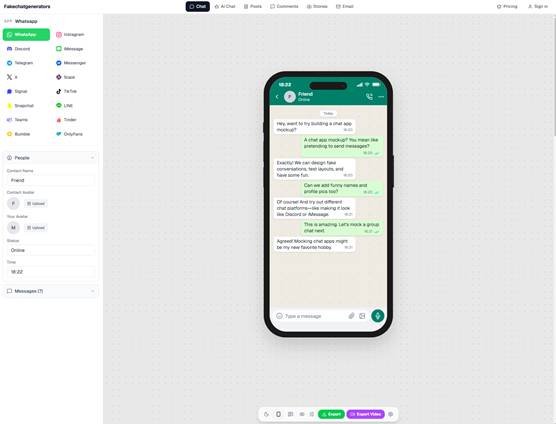
fakechatgenerators.com lets you mock up chat screenshots across 16 platforms
The screenshot doesn’t just tell a story. It tells the story for you, in a layout designed to feel like evidence.
Reddit’s outrage machine runs on plausibility
Here’s the key: a fake chat doesn’t have to be perfect. It has to be plausible enough to activate the comment section.
Reddit is a platform built for argument. It rewards the clever rebuttal, the moral grandstanding, the armchair diagnosis. A screenshot is the ideal kindling because it’s specific. It gives everyone something to latch onto.
Watch what happens in a typical thread:
- The top comments assume it’s real and sprint to verdicts.
- A smaller group questions it, but gets downvoted for “being cynical.”
- Another faction nitpicks formatting, like they’re doing forensics on a suburban custody dispute.
- Someone declares “this is fake,” someone else declares “even if it’s fake, it’s still a good lesson,” and suddenly we’re debating philosophy instead of the screenshot.
In other words, whether it happened is almost secondary. The post has already done its job: it created a stage where strangers can perform righteousness.
That’s why “creative writing” subs and “relationship advice” subs often feel like cousins. The content is different, but the audience reaction is the same dopamine loop: surprise, judgment, consensus, dunk.
The tells are obvious, until they aren’t
People love to brag they can spot a fake. “No one talks like that.” “Wrong font.” “Why would they say it in writing?” Then they fall for the next one because the next one is better crafted, or because it hits a familiar fear.
Sometimes the screenshot is fake but the emotional dynamic is real. A manipulative apology. A jealous partner escalating. A boss using corporate-speak to threaten someone. The internet has seen these patterns so often that a fabricated example can still feel true.
Plus, we’ve trained ourselves to accept artifacts. Cropped edges. Missing timestamps. Conveniently blurred names. The classic “I changed some details for privacy.” Those could be honest, or they could be camouflage. Either way, the comment section usually doesn’t wait around for verification.
And why would it? Verification is slow, boring, and socially risky. If you’re the person insisting on proof, you become the vibe killer. The thread isn’t a courtroom. It’s dinner theater.
Enter the counter-industry: detection and distrust
Every boom has a cleanup crew. As synthetic media gets easier to produce, tools that flag AI generation, NSFW content, violence, and document tampering are stepping in as the dour grown-ups with clipboards. The promise is speed and scale: sub-150ms latency, claims of 98.7% detection accuracy across 50+ generative models, from Midjourney and DALL-E to Stable Diffusion, Flux, Ideogram, Google Gemini, and GANs.
That’s the pitch of an ai image detector, and it’s not hard to see why journalists, trust and safety teams, banks, marketplaces, and legal groups would want it. If your job is preventing fraud or stopping a harassment campaign, you can’t rely on “the pixels feel off.” You need triage.
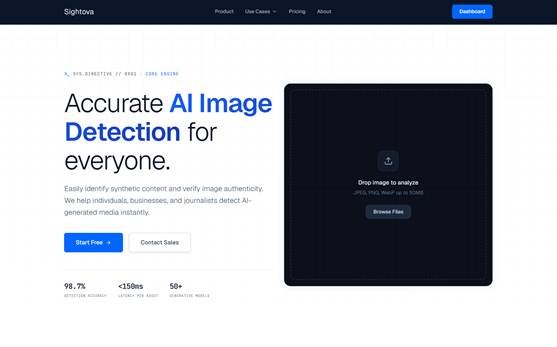
sightova.com flags AI-generated, tampered, NSFW, and violent imagery in milliseconds
But detection also changes the vibe. Once people learn that “proof” can be fabricated, they start doubting everything, including the real stuff. That’s not a small cultural shift. It means the screenshot, once a social trump card, becomes just another contested object in a world where every object can be forged.
The internet didn’t just lose innocence. It lost a shared sense of what counts as evidence.
Why we keep falling for it anyway
Because it’s fun.
There’s a reason “fake but entertaining” content doesn’t die. It fills the same role as gossip, tabloid headlines, and campfire horror stories. It gives you a safe threat, a scenario to react to, a chance to rehearse your values. Reddit, with its upvote economy, is basically built to encourage that rehearsal.
Also, many people don’t come to these threads for the truth of the specific chat. They come for the social act of reacting. It’s a participatory genre. The screenshot is the prompt, the comments are the real event.
If that sounds bleak, it’s also kind of funny. Humans have always loved moral theater. The only difference is we used to do it about Greek kings and Victorian scandals. Now we do it about “my boyfriend texted me this at 2:13 a.m.” and we demand to see the receipts.
A modest proposal for not being the easiest mark in the room
You don’t need to become a full-time skeptic with a forensic toolkit. You just need a couple of habits that slow the outrage reflex.
- Treat screenshots like anecdotes, not affidavits. They can support a story, but they aren’t the whole story.
- Notice what’s missing. A single cropped exchange is a curated narrative. Curated narratives are not automatically lies, but they are always incomplete.
- Ask what the post is trying to make you feel. If it’s engineered to trigger instant fury, it’s probably engineered in other ways too.
- Reward nuance when you see it. Upvotes are tiny, but they’re not meaningless. If you’re going to participate in the theater, you might as well tip the actors who improve the script.
Reddit’s favorite drama isn’t going anywhere. The tools are too easy, the incentives too strong, and the audience too eager. Fake texts will keep generating real outrage, because outrage is one of the few renewable resources the internet never seems to run out of.
Still, it’s worth remembering: a screenshot is not a conscience. It’s a picture of a story someone wants you to believe. The rest is on you.